
Setup Your Dashboard
Account setup
Begin by creating a new project and then add your brand name and website URL to get started.
Next, define your business context. Add your industry, primary market location, target country, and the key services or products you offer. This helps GoVISIBLE understand where and how your brand should appear.
Navigation overview
Step 1: Project Basics
It starts with basic information about your brand and website. Add your brand name and website URL to initiate your project.
Step 2: Business Details
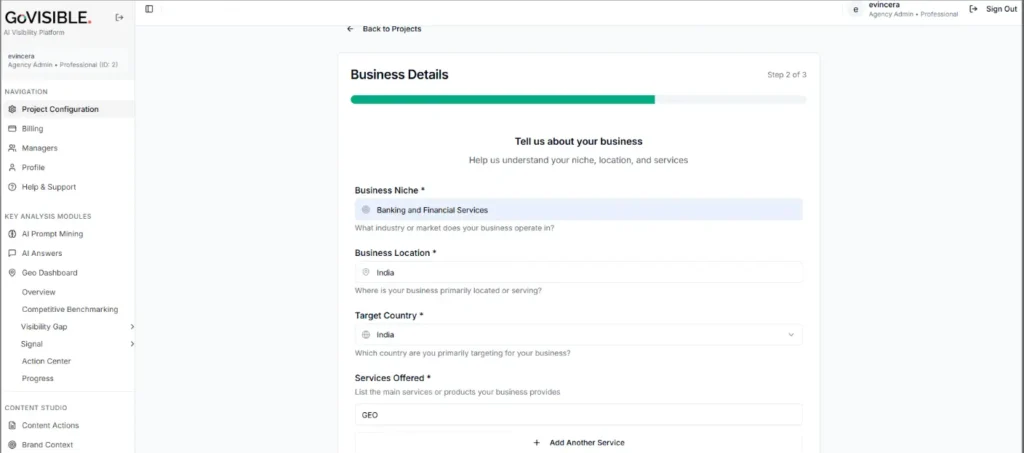
While the GoVISIBLE ai agent will find out the business details, please verify your niche, location, and services. Update your business context by specifying your business niche, location, target country, and up to 10 key services or products you offer; if you see any disconnects.
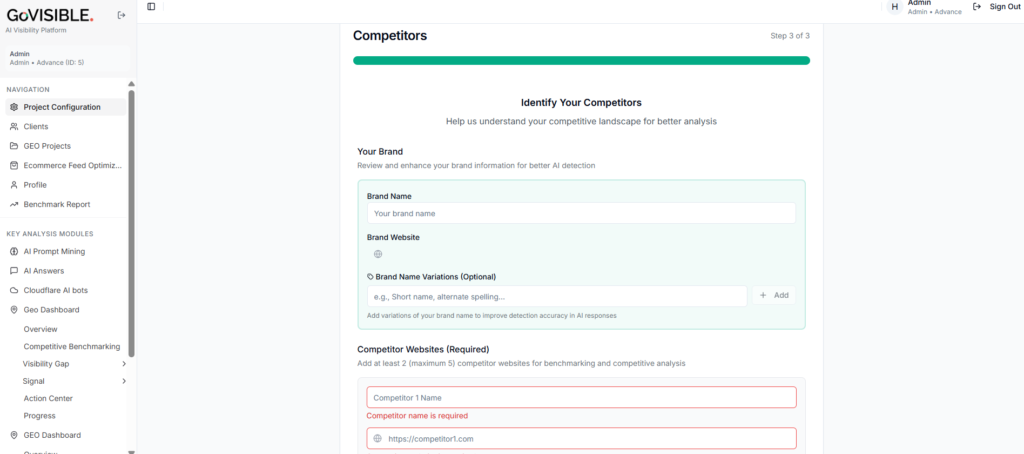
Start by refining your brand details to improve detection accuracy in AI-generated responses. Add your brand name and, if needed, include brand name variations to capture different ways your brand may be referenced.
Step 3: Competitors
Selecting competitors
Competitor selection in GoVISIBLE isn’t just about listing similar brands; it defines the benchmark for your visibility across AI-generated responses.
GoVISIBLE automatically recommends competitors based on your industry, target market, and AI search landscape. If needed, you can further refine this list by adding or editing competitors using their brand names and website URLs.
While selecting competitors, keep these best practices in mind:
- Choose businesses targeting the same audience or solving similar problems, not just those offering identical products.
- Make sure they operate in the same region or serve a similar market.
- Select brands that are currently active and visible in your category.
- Prioritize competitors that frequently appear in AI-generated responses or high-intent searches.
A well-defined competitor set helps GoVISIBLE measure your presence, benchmark your strategy, identify content gaps and opportunities, and gain insights to improve your SEO positioning. So, you have a clear understanding of where you stand and where and how to improve.
Next, review the suggested competitors and update the list based on relevance. Add at least 2 and up to 5 competitor websites for effective benchmarking and analysis.