
Setting Up Prompts
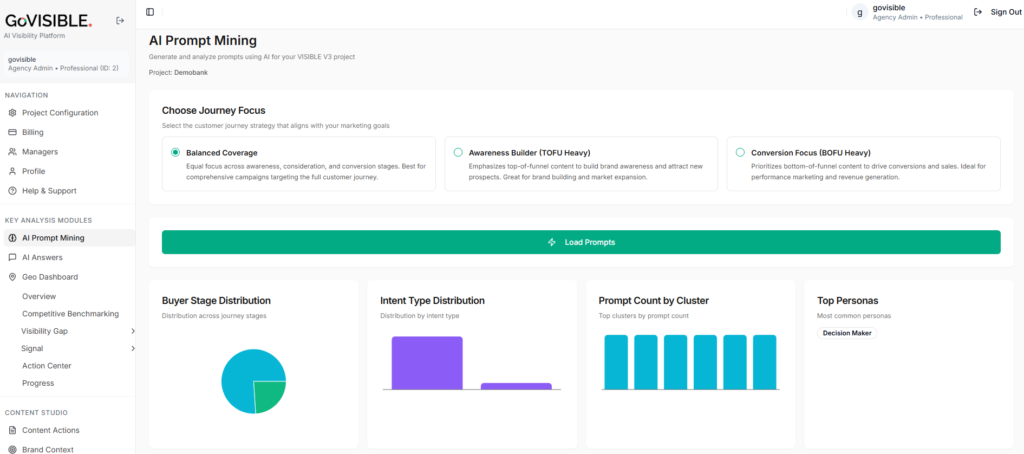
Prompts represent the questions users ask across AI search platforms.
In the AI Prompt Mining Tab, you can generate and analyze relevant prompts for your brand. GoVISIBLE runs these prompts across major AI platforms such as ChatGPT, Perplexity, Gemini, Microsoft Copilot, and Google AI Mode to identify which brands and sources are being mentioned in AI-generated responses.
Choosing Your Approach

- – Awareness Builder (TOFU-focused) –Designed to build brand awareness and attract new audiences at the top of the funnel.
- – Conversion Focus (BOFU-focused) –Prioritizes prompts that indicate high purchase intent and help drive conversions.
- – Balanced Coverage – Ensures coverage across awareness, consideration, and conversion stages of the customer journey.
Types of prompts
- Branded Prompts: Prompts where the user explicitly mentions a brand name. These prompts show existing demand. Here, the user already knows the brand and is seeking evaluation, comparison, or validation.
- Example: “Is Nike better than Adidas for running?”
- Non- Branded Prompts: Prompts where no brand is mentioned. These prompts show the opportunity to be discovered.
- Example: “Best running shoes for beginners”
Next, generate your first 50 prompts. GoVISIBLE suggests prompts based on your brand services. You can review and change them, edit existing prompts, or manually add new ones using the Add Prompts option.
Best practices (GoVISIBLE follows)
- Write prompts the way real users ask- clear, natural.
- Include both branded and non-branded prompts to understand demand as well as discovery.
- Keep a higher share of non-branded prompts to capture broader discovery and category-level visibility.
- Think in clusters, not isolated prompts, group related queries around a topic or intent.
- Avoid leading or biased phrasing. For example:
- Biased: “Why Nike is the best running shoe?”
- Neutral: “Is Nike a good option for running?”
- Add relevant context (product, category, or use case) to improve the accuracy of insights.
- Avoid overlapping contexts in prompts as it may create bias in analysis.