
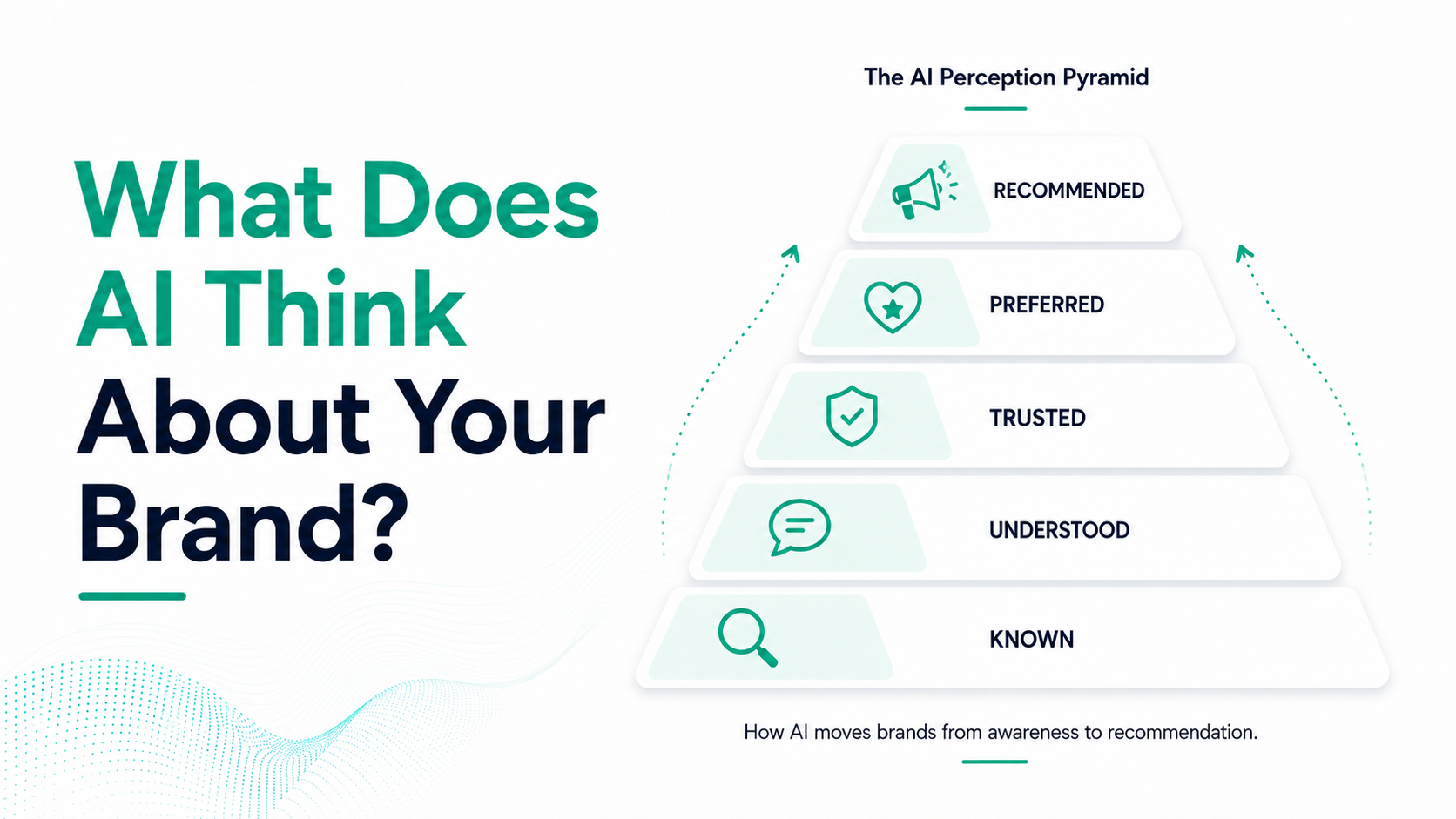
Understanding the AI Perception Pyramid
You probably know what your customers think about your brand.
Or at least, you try to.
You invest in brand tracking. You run customer surveys. You analyse reviews and NPS scores. You listen to social conversations. You conduct focus groups.
For decades, marketers have built entire disciplines around one fundamental question:
What do people think about us?
But there is another question that is becoming increasingly relevant:
What does AI think about your brand?
It may sound like a philosophical question. It isn’t.
When someone asks ChatGPT, Gemini, Perplexity, Copilot or an AI-powered search experience:
- What is this company known for?
- Which brands are best for this?
- How does Brand A compare with Brand B?
- What would you recommend for my specific requirement?
AI has to construct an answer.
And in doing so, it creates, expresses and applies an understanding of your brand.
That understanding may be very close to the positioning your marketing team has spent years building.
Or it may be surprisingly different.
That is the gap marketers need to start paying attention to.
Recent research reflects how quickly AI is becoming part of discovery and decision-making. McKinsey’s 2025 AI Discovery Survey found that nearly half of consumers use AI-based search during purchase journeys. Google has also reported that AI-powered search experiences are helping users move toward faster and more confident decisions. Meanwhile, AI platforms themselves are becoming more capable of comparing products, interpreting constraints and surfacing recommendations rather than simply returning a list of links.
The implication for brands is simple:
You are no longer communicating only with your audience. You are also operating inside an information ecosystem that AI systems use to understand, describe, compare and sometimes recommend you.
The uncomfortable gap between what you say and what AI says
Imagine a skincare brand whose positioning is:
“India’s most innovative premium skincare brand.”
That is how the company wants to be understood.
Now imagine a potential customer asks an AI assistant about the brand and gets a description closer to:
“A popular skincare brand known for affordable products.”
Neither statement necessarily has to be completely wrong.
But they describe very different positions in the customer’s mind.
Or take a technology company that positions itself as:
“A strategic enterprise technology partner.”
But when AI is asked about the company, it consistently describes it as:
“An IT outsourcing company known for cost-effective delivery.”
Again, there is a gap, and that gap matters.
Because you control the messaging on your website.
You can define your positioning statement. You can write the campaign. You can decide how your sales deck describes the company.
But you do not completely control the broader ecosystem from which AI may gather, retrieve, or synthesize information about your brand.
Your website is only one part of the picture.
AI-enabled discovery can draw on structured information, first-party and third-party data, product information, reviews and other relevant sources depending on the platform and query. For example, OpenAI explains that its shopping experiences can consider structured metadata, product descriptions, reviews and other third-party content, while Google is similarly building AI shopping experiences around its large product and information ecosystem.
So the real question is not simply:
“What are we telling the market?”
It is also:
“What picture of our brand can AI construct from the information available about us?”
AI is building a mental model of your brand
Think about a person you know casually.
You may know their name and where they work.
That is one level of understanding.
You may also know what they are good at, what kind of work they do and what other people say about them.
That is a deeper level.
And if someone asks you:
“Would you recommend this person for this particular job?”
you need something more.
You need confidence.
You need context.
You need to understand how that person compares with alternatives.
Brand perception inside AI works in a similar way.
AI does not have your brand book sitting in front of it.
It does not automatically accept your positioning simply because you wrote it on your website.
Instead, depending on the platform and query, it works with information and signals available to it across an ecosystem that may include:
- Your website and owned content
- Product and service information
- Structured data
- Reviews and ratings
- News coverage
- Industry publications
- Comparisons
- Third-party websites
- Customer discussions
- Expert commentary
- Other relevant sources
Over time, or more accurately, across the information available to a model or retrieved for a particular answer—these pieces can form something like a mental model of your brand.
That model influences how AI may:
- Describe your brand
- Categorise your products or services
- Associate you with specific strengths or weaknesses
- Compare you with competitors
- Determine your relevance to a particular need
- Decide whether to include you in a recommendation
This is why simply asking, “Does ChatGPT know my brand?” is not enough.
AI perception is not binary.
There are layers.
Introducing the AI Perception Pyramid
At GoVISIBLE, we have been thinking about this through a simple framework:
The AI Perception Pyramid
The framework has five levels:
KNOWN → UNDERSTOOD → TRUSTED → PREFERRED → RECOMMENDED
Each level represents a deeper form of AI perception.
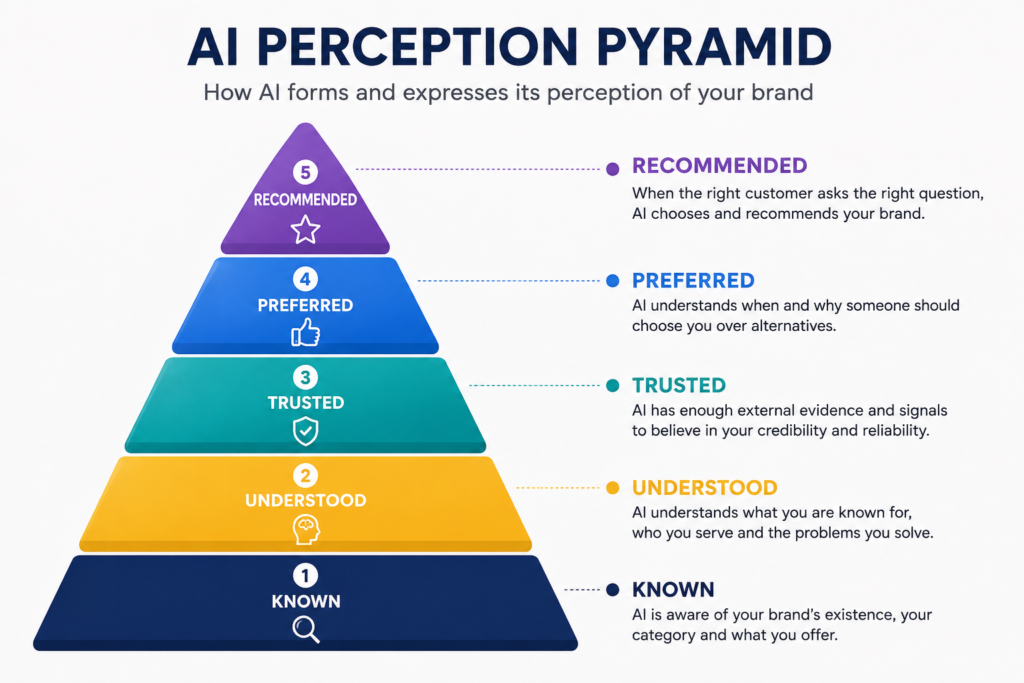
The important idea is this:
Being known by AI is not the same as being understood. Being understood is not the same as being trusted. And being trusted does not guarantee that you will be recommended.
Let’s look at each layer.
1. Known: Does AI know who you are?
This is the foundation.
At this stage, AI can correctly identify your brand and answer basic questions such as:
- Who are you?
- What category do you operate in?
- What do you sell?
- Where do you operate?
A simple test might be:
“What is [Brand Name]?”
If the answer is broadly accurate, your brand is Known.
But this is also where many marketers stop.
They ask an AI platform about their company, receive a reasonably accurate description and conclude:
“Great. AI understands us.”
Not necessarily.
Knowing that a brand exists is the easiest part of the journey.
A person can know that Nike exists without understanding which products or running needs it may be best suited for.
A business buyer can know the name of a technology company without understanding what differentiates it from dozens of competitors.
Recognition is not understanding.
And that brings us to the second level.
2. Understood: Does AI understand what you are actually known for?
This is where the questions become more interesting.
Ask:
“What is [Brand] best known for?”
Or:
“Who is [Brand] best suited for?”
Or:
“What problems does [Brand] solve?”
Now you are moving beyond recognition.
You are testing whether AI understands your relevance.
This is also where positioning gaps often become visible.
A company may believe it is known for innovation.
AI may primarily associate it with affordability.
A brand may want to be positioned as premium.
AI may consistently describe it as mass market.
A software company may have expanded into a new strategic category, while AI still associates it primarily with the service it offered five years ago.
In all these cases, the brand may be perfectly Known but not fully Understood.
And that distinction matters because relevance drives the next stage of discovery.
If AI does not understand what you are good at, it will struggle to know when you are relevant.
3. Trusted: Does AI have enough evidence to believe what it knows?
Every brand can make claims.
“We are the best.”
“We are innovative.”
“We are a market leader.”
“We offer unmatched quality.”
The harder question is:
What evidence exists beyond your own website?
This is the difference between being Understood and being Trusted.
AI systems and AI-powered experiences increasingly work with information from multiple sources. In product discovery, for example, ChatGPT’s current shopping experience can use merchant data, public product information and other relevant retail sources to compare options against a user’s needs and constraints.
The same broader principle matters for brand perception.
If a company claims expertise but there is little evidence beyond its own marketing, AI may be able to repeat what the company says without having strong independent signals that reinforce the claim.
Trust can be strengthened by things such as:
- Credible third-party coverage
- Customer reviews
- Expert commentary
- Demonstrable experience
- Consistent information across relevant sources
- Strong product or service evidence
- Recognisable authority within a category
The key question is:
Is there enough evidence in the information ecosystem to support the perception you want AI to form?
Because understanding tells AI what you are.
Evidence gives AI greater confidence in that understanding.
4. Preferred: Does AI understand when you are the better choice?
Now the competitive context enters the picture.
This is where your brand is no longer evaluated in isolation.
Ask:
“Compare [Your Brand] with [Competitor].”
Then take it a step further:
“When would you choose [Brand] over [Competitor]?”
This is a revealing exercise.
It forces AI to articulate differences.
For example:
- Brand A may be better for affordability.
- Brand B may be better for enterprise buyers.
- Brand C may be better for beginners.
- Brand D may be better for premium users.
At this level, the question is no longer simply:
“Does AI know us?”
It becomes:
“Does AI understand when we are the better choice?”
That is what we call Preferred.
A brand can be credible and well understood, yet still have no clear advantage in AI’s comparative framing.
That is a significant problem.
Because recommendation requires differentiation.
If AI cannot identify why you are more relevant for a particular person, need or context, there is little reason for it to prioritise you over an alternative.
5. Recommended: When the right customer asks the right question, does AI choose you?
This is the top of the pyramid.
And it is also where things become highly contextual.
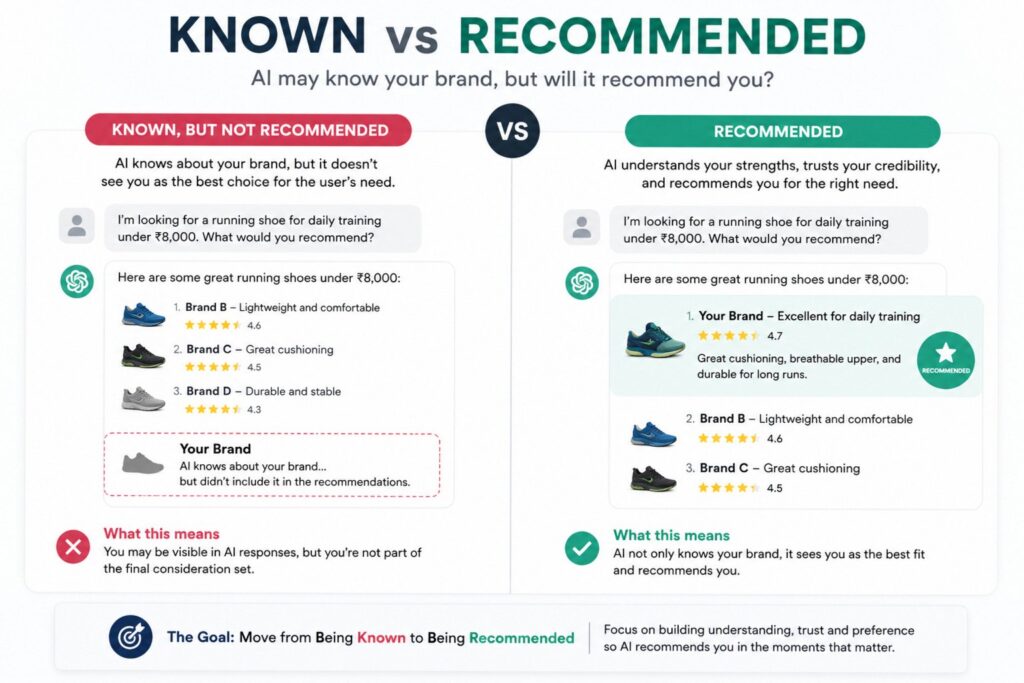
Imagine you sell running shoes.
Instead of asking:
“Tell me about Brand X.”
ask:
“I’m a beginner runner. I run three times a week, have a budget of ₹8,000 and need comfortable shoes for road running. What would you recommend?”
Now the AI has a more complex task.
It has to:
- Understand the user’s need
- Interpret the constraints
- Identify relevant options
- Compare trade-offs
- Surface a recommendation
And Brand X may not appear.
Even if the AI knows the brand.
Even if it understands the products.
Even if the brand is credible.
Why?
Because recommendation is contextual.
The brand has to be the right fit for:
- This customer
- This need
- This budget
- This use case
- This set of constraints
This is particularly visible in AI shopping experiences. OpenAI states that ChatGPT product results can take into account factors such as the user’s query, context, price, reviews and other relevant product information. The same product will not necessarily be the right answer for every prompt.
That leads to an important conclusion:
Being Known does not automatically make you Recommended.
And being recommended for one use case does not mean you will be recommended for another.
Why measuring AI mentions alone is not enough
A growing number of brands are starting to ask:
“How many times was my brand mentioned by AI?”
It is a useful question.
But it is only the beginning.
A mention tells you that you appeared.
It does not necessarily tell you:
- What AI understands about your brand
- What attributes it associates with you
- Whether those associations are accurate
- Whether it trusts the claims around your brand
- How it compares you with competitors
- Which customer segments you are relevant for
- Whether it would actually recommend you
Consider these two scenarios.
Brand A
Appears in 80% of broad category questions.
But when users ask specific, high-intent questions, it is rarely recommended.
Brand B
Appears less frequently in broad conversations.
But consistently appears when users ask about a particular use case where the brand has a strong product-market fit.
Which brand has better AI visibility?
The answer depends on what you are trying to measure.
That is why we believe AI visibility should move beyond a single metric.
Visibility has depth.
The AI Perception Pyramid provides one way to understand that depth.
How to test your own brand
You do not need a complex research project to start.
Take your brand through the five levels of the AI Perception Pyramid.
Level 1: Known
Ask:
What is [Brand]?
Check whether the basic facts are accurate.
Level 2: Understood
Ask:
What is [Brand] best known for?
Who is [Brand] best suited for?
What problems does [Brand] solve?
Compare the answers with your intended positioning.
Level 3: Trusted
Ask:
Why is [Brand] considered credible in this category?
What evidence supports its reputation?
Then look beyond the answer itself.
Where is the evidence coming from?
Is your brand’s reputation supported by a broad ecosystem, or primarily by your own claims?
Level 4: Preferred
Ask:
When would you choose [Brand] over [Competitor]?
This is where your differentiation becomes visible—or where you discover that it is not yet clear.
Level 5: Recommended
Now remove your brand from the question.
Ask a genuine customer question:
“I’m looking for [product/service] with [specific need and constraints]. What would you recommend?”
Do not ask for your brand.
Let AI decide.
Then test multiple relevant scenarios.
Because the goal is not to find one prompt where your brand appears.
The goal is to understand:
For which needs, contexts and audiences does AI consider your brand relevant enough to recommend?
The strategic implication for CMOs
For years, marketing leaders have measured awareness, perception, trust and preference.
Those ideas are not going away.
But AI introduces another layer.
AI is increasingly participating in the moments where consumers and buyers:
- Discover options
- Learn about brands
- Compare alternatives
- Narrow down choices
- Ask for recommendations
McKinsey’s recent research argues that AI-powered search is already influencing discovery and purchasing journeys, while OpenAI and Google continue to build AI experiences specifically designed to compare products and help users make decisions based on their preferences and constraints.
This means the question for marketing leaders is evolving.
It is no longer only:
“What do customers think about our brand?”
It is increasingly also:
“How is AI likely to describe, interpret and position our brand when customers ask?”
And eventually:
“When the right customer asks the right question, does AI recommend us?”
Where does your brand sit in the AI Perception Pyramid?
The AI Perception Pyramid is not intended to suggest that AI has a single, fixed opinion of a brand.
It doesn’t.
Answers can vary by:
- Platform
- Prompt
- User context
- Geography
- Time
- Available information
- The specific need being expressed
That is precisely why the challenge is interesting.
The goal is not to optimise for one answer.
It is to understand the patterns.
Are you consistently understood correctly?
Are there recurring attributes associated with your brand?
Are competitors more strongly associated with certain use cases?
Do you have evidence supporting the positioning you want to own?
And when a high-intent question appears, do you enter the recommendation set?
These are the questions that will increasingly sit alongside traditional measures of brand health.
Because in the AI era, being visible is only the first step.
You can be Known without being Understood.
You can be Understood without being Trusted.
You can be Trusted without being Preferred.
And you can be Preferred without being Recommended in every situation.
The journey looks like this:
KNOWN → UNDERSTOOD → TRUSTED → PREFERRED → RECOMMENDED
And perhaps the most important question for every CMO is no longer simply:
“Is my brand visible in AI?”
It is:
“Where does my brand sit in AI’s Perception Pyramid—and what will it take to move higher?”
Because in a world where AI increasingly helps people discover, compare, and choose, being known may only be the beginning.

0 Comments