
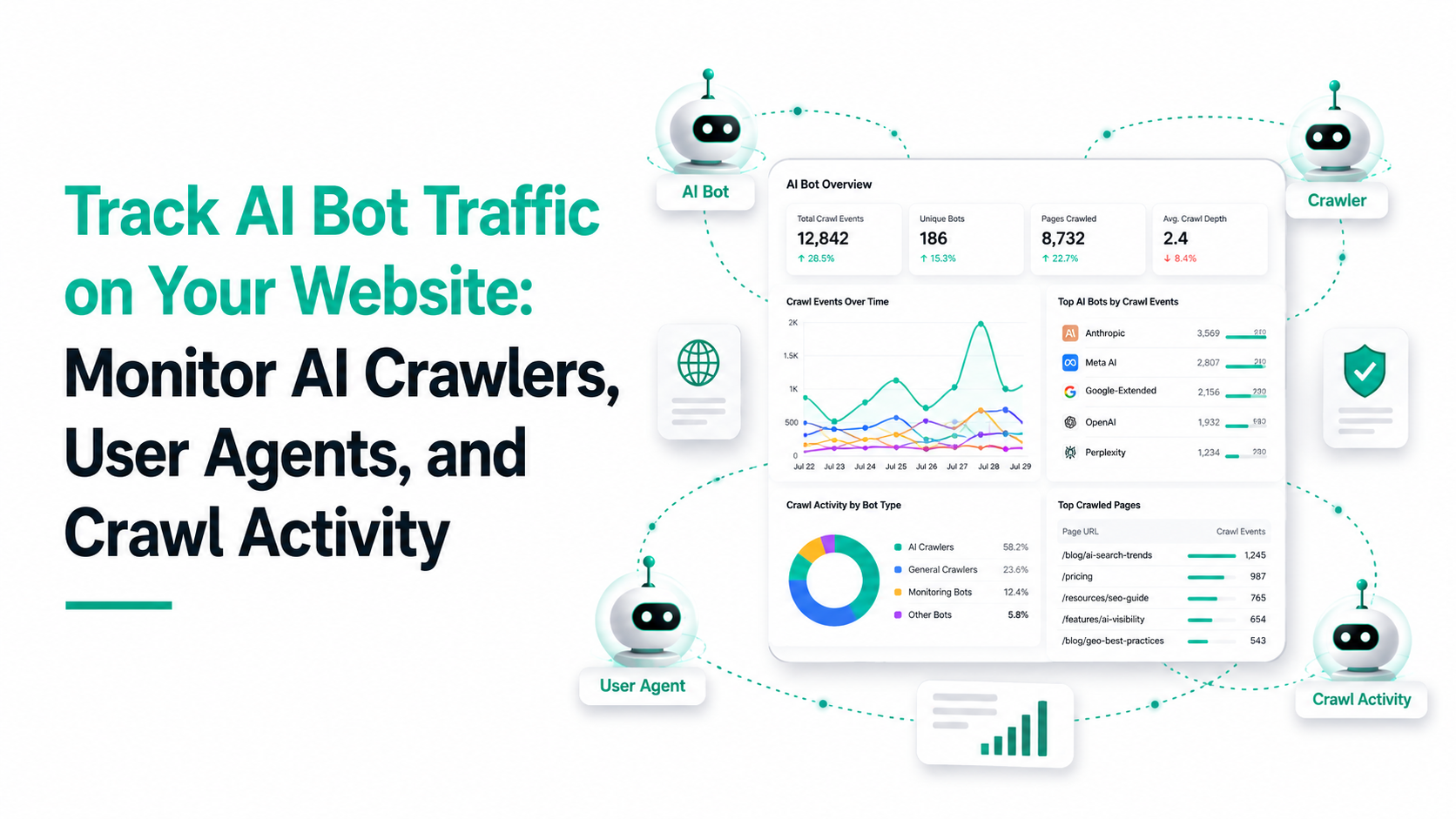
AI crawlers are becoming a normal part of website traffic. They visit pages, read content, follow links, and leave behind technical signals that can tell you how your website is being accessed by AI systems.
AI bot tracking helps you see which AI crawlers are accessing your website, which pages they visit, and how often they return. For the SEO and Marketing Team, this is useful for operational data. It gives you visibility into a new layer of crawler activity that is becoming more important as AI powered tools, assistants, and answer engines interact with web content.
Instead of checking raw server logs manually, the AI Bot Tracker plugin helps you monitor crawler visits inside your WordPress dashboard.
What Is AI Bot Activity?
AI bot activity refers to visits made by crawlers associated with AI systems, large language models, AI search engines, AI assistants, or generative platforms.
When an AI crawler accesses a website, it may request a page, read content, follow links, or collect publicly available information. These visits are usually identified through technical details such as:
- Bot type
- User agent
- IP address
- Visited URL
- Date and time of visit
- Crawl frequency
This data helps you understand how AI crawlers are interacting with your website. It does not tell you exactly how an AI model will use your content, but it gives you a clearer picture of whether AI bots are reaching your pages.
That visibility matters because websites are no longer accessed only by human visitors and traditional search engine crawlers. AI crawlers are now part of the broader discovery ecosystem.
What You Can Learn From AI Bot and Crawler Visits
AI bot visits often happen in the background. They may not appear clearly in standard analytics tools because many analytics platforms depend on browser scripts, cookies, or human-session tracking. Bots may not behave like human users, and their activity may be better understood through server-side or crawler-level data.
Tracking AI bot visits helps you answer important questions:
- Are AI crawlers visiting my website?
- Which pages are they accessing?
- Are my important pages being reached?
- How often are AI crawlers returning?
- Which sections of the website receive more AI bot activity?
- Are some key pages missing from AI crawler visits?
With this data, you can make better decisions about content accessibility, site structure, internal linking, robots.txt rules, and technical website health.
Read more: Learn how AI crawlers impact Generative Engine Optimization in our guide on AI Crawlers Analysis for Generative Engine Optimization.
What AI Crawler Logs Can Tell You
AI bot logs can reveal patterns that are difficult to see in normal analytics reports.
1. Which AI Bots Are Visiting
Different AI bots may access your website at different times. Some may visit regularly, while others may visit occasionally. Tracking bot types helps you understand which AI crawlers are showing activity on your site.
For example, you may see visits from bots associated with AI assistants, AI search tools, or LLM platforms. Knowing which bots are visiting helps you understand the type of AI crawler activity happening on your website.
2. Which Pages Are Being Accessed
This is one of the most useful parts of AI bot tracking.
If AI crawlers are only visiting a few blog posts but not your important service pages, product pages, documentation, or category pages, that is useful to know. It may indicate that certain sections are easier to discover, better linked, or more accessible than others.
For a business website, this can help you check whether important commercial pages are being reached. For a publisher, it can show whether editorial content is receiving crawler activity. For a SaaS company, it can help identify whether feature pages, help docs, and comparison pages are being accessed.
3. How Often Crawlers Return
Crawl frequency can show whether AI bots visit once, occasionally, or repeatedly.
A page that receives repeated AI crawler visits may be seen as more accessible or more frequently discovered. A page that never receives AI bot activity may need review from a technical or linking perspective.
This does not guarantee AI visibility, but it gives you useful crawler-level evidence.
4. Which Content Sections Get More Attention
AI bot tracking can help you compare activity across content types.
You may find that blogs receive more AI crawler visits than landing pages. Or that documentation receives more activity than product pages. Or that older resources are accessed more often than recently published content.
These patterns can help you understand how crawlers are moving through your site and which areas are being discovered more often.
5. Which Important Pages Are Missing
Sometimes the most valuable insight is not what crawlers visit, but what they do not visit.
If your key pages are not receiving AI bot activity, it may be worth reviewing whether they are crawlable, internally linked, blocked, slow to access, or difficult for bots to discover.
This makes AI bot tracking useful for website maintenance, not just reporting.
GoVISIBLE AI Bot Tracker
GoVISIBLE AI Bot Tracker helps website owners monitor AI-related bots, crawlers, and user agents accessing their site. It identifies visits from known AI crawlers, AI search bots, user-triggered fetchers, and AI-adjacent data crawlers, then shows useful details such as bot name, category, IP address, visited URL, and visit date.
The purpose is simple: make AI bot activity visible.
Instead of manually checking technical logs, you can view AI crawler visits in a more accessible format.
What This Data Can Help You Decide
AI bot tracking does not automatically tell you what to do, but it gives you evidence for better decisions.
For example, if a key page is not receiving AI bot visits, you may want to check whether it is properly linked from other pages, accessible to crawlers, or blocked by technical settings.
- If one content section receives regular AI bot activity, you may want to review whether that section is up to date, accurate, and connected to other important pages.
- If AI bot visits increase after a content update, that may suggest crawlers are revisiting the site more often.
- If unknown or unwanted bots appear frequently, you may want to review your bot management approach.
The main benefit is visibility. Once you can see AI bot activity, you can start asking better questions about your website.
AI Bot Tracking Is a New Layer of Website Intelligence
- Analytics tools show human behavior.
- Search tools show visibility and traffic from search engines.
- Crawler tracking shows how bots access your website.
For modern websites, this can be useful because AI systems are becoming part of how information is discovered, summarized, referenced, and recommended.
Final Thoughts
LLM Crawlers are already visiting websites. The important question is whether you can see that activity clearly.
GoVISIBLE AI Bot Tracker helps website owners monitor crawler visits, understand which pages are being accessed, and review crawler activity over time inside WordPress. It does not guarantee visibility in AI-generated answers, and it does not replace a broader website strategy. But it gives you something important: clear data about AI crawler activity. For a Team managing a website, that data can help support better decisions around content, technical access, crawler visibility, and website readiness in an AI-driven discovery environment.
Install the GoVISIBLE AI Bot Tracker Plugin to start monitoring AI bot activity and understand how AI crawlers interact with your website.
0 Comments