
The way brands get discovered is being rewritten — not gradually, but in real time. In the span of just 30 days between mid-May and early June 2026, Google shipped an official GEO optimization guide, a dedicated AI performance report inside Search Console, a native AI Assistant channel in GA4, six new Merchant Center feed attributes built explicitly for conversational commerce, and embedded ads directly inside AI-generated answers. Stripe closed agentic checkout deals with Google, OpenAI, Microsoft, and Meta in the same window. These are not experimental features, they are infrastructure decisions made by the largest platforms in the world, and infrastructure decisions don’t get reversed.
At GoVISIBLE, we have been tracking the Generative Engine Optimization space as practitioners developing products and building GEO strategies for brands across industries. What the data from the last six weeks confirms is something we have been telling our clients for a while: the brands that earn visibility inside AI-generated answers today are building a compounding advantage that will be very difficult to close later. This brief is our read on the signals that matter most right now.
Platform-Level Signals
1. Google Search Console Now Has a Dedicated AI Performance Report
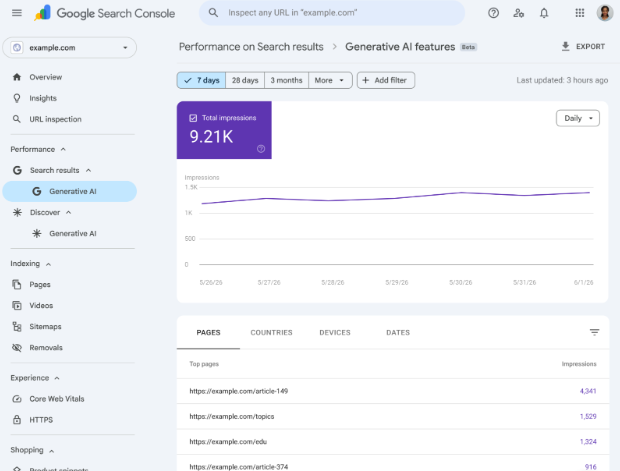
On June 3, 2026, Google added dedicated generative AI performance reports to Search Console, isolating impressions from AI Overviews, AI Mode, and generative AI features in Discover for the first time. This is the official first-party infrastructure.
- The report data starts from May 18, 2026.
- A new toggle also lets site owners block their content from AI Overviews, AI Mode, and Discover AI — reinforcing that AI visibility is now a deliberate, controllable brand decision
Why this matters for management: Google just built a dedicated measurement layer for AI visibility. When a platform of Google’s scale ships a dedicated reporting infrastructure, it signals the channel is permanent, not experimental.
2. Google Published Its First Official GEO Guide
On May 15, 2026, Google published its first official guide titled “Optimizing your website for generative AI features on Google Search” inside Google Search Central. The guide explains how AI Overviews, AI Mode, and future agentic experiences interact with websites.
This is the first time Google has released prescriptive guidance specifically for its generative AI search features. Two years passed between AI Overviews launching and Google’s publishing official optimization guidance.
Why this matters: Google formally acknowledging GEO as a discipline with its own official documentation is a validation milestone — comparable to when Google first published SEO guidelines a decade ago.
Source: Optimizing your website for generative AI features on Google Search
3. Google Analytics 4 Added a Native “AI Assistant” Channel
Google confirmed on May 13, 2026, that a native “AI Assistant” channel has been added to GA4’s Default Channel Group, requiring no configuration from property owners. When Google Analytics detects a referrer matching a recognized AI assistant, it automatically assigns the value “ai-assistant” to the medium dimension. Google names ChatGPT, Gemini, and Claude as examples of recognized assistants.
For years, when someone clicked through to a website from a ChatGPT response, Google Analytics grouped that visit with every other referral from the internet; a link from a major news outlet looked the same as a link from an AI assistant. That changed on May 13, 2026.
Why this matters: Google treating AI assistants as a distinct traffic channel on par with Organic Search, Paid Search, and Social is a structural market signal. Brands now have native, out-of-the-box measurement for this channel.
4. Google AI Mode Rolled Out “Preferred Sources” Globally
Date: May/June 2026
Google rolled out its Preferred Sources feature globally and also added Preferred Sources in AI Mode. This allows users to designate specific brands or publishers as preferred within Google’s AI search experiences. Search Engine Roundtable
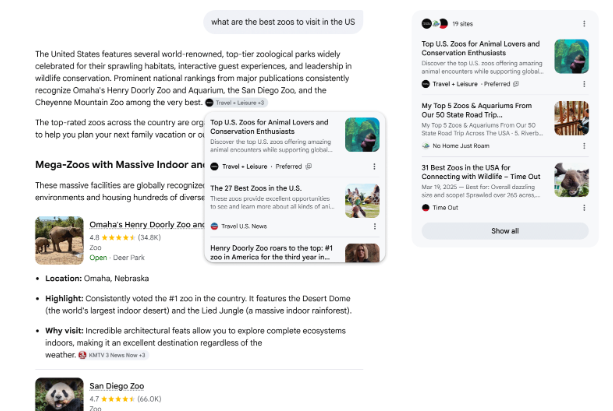
Why this matters for GEO: A brand that earns “preferred source” status gets prioritized in AI-generated answers for returning users. This is a direct, algorithmic brand-visibility lever that GEO helps brands earn.
Google Marketing Live 2026 — AI Is Now the Ad Surface
Google Marketing Live, held in late May 2026, was entirely organized around AI-native commerce. Key announcements for brand teams
Ads Are Now Inside AI Answers. Google has fully embedded ads into AI Overviews and AI Mode. These aren’t banner placements sitting next to a result — they surface when relevant to the user’s query and the AI-generated response itself. The traditional model of bidding on a keyword and getting a click is being layered over by an AI that decides when your ad is contextually relevant to a conversation.
Source: About ads and AI Overviews
Business Agent for Leads: A Brand’s Own AI Inside Ads. Google launched “Business Agent for Leads,” which places a smart brand agent directly in your ad. Instead of filling out a static form, a user can click “Chat” to get instant answers based on your website, turning a practical interaction into a valuable lead. Brands like Chewy, Gap, and L’Oreal have been live in the Direct Offers pilot since January 2026.
Source: A new generation of ads for the AI era of Search
AI Performance Insights in Merchant Center Google also launched AI Performance Insights in Merchant Center, giving retailers structured reporting on how their products perform in AI-driven shopping surfaces.
Source: A new generation of ads for the AI era of Search
Retailers can add conversational product attributes and updated descriptions directly inside Merchant Center, and Google’s AI systems then use that structured data to better match products with conversational shopping queries.
Source: How to use conversational attributes
Google released Gemini 3.5 Flash in search with a “ton of new agentic features,” and also rolled out an intelligent search box at Google I/O 2026. The theme was agentic search, replacing passive keyword lookup
Source: A new era for AI Search
The Agentic Commerce Protocol (ACP) — Open Standard for AI Transactions
Stripe and OpenAI co-developed the Agentic Commerce Protocol (ACP), an open standard enabling brands to sell through AI agents while retaining full control over what’s sold, how their brand shows up, and how orders are fulfilled. ChatGPT users in the US can already buy from Etsy merchants and, soon, from over a million Shopify merchants, including Glossier, Vuori, Spanx, and SKIMS, directly in chat.
Refer: Stripe Instant Checkout
Google’s equivalent is the Universal Commerce Protocol (UCP), a coalition-backed open protocol announced in January 2026. Most brands will need to support both ACP and UCP to remain discoverable across the full AI commerce landscape.
Source: Getting started with Universal Commerce Protocol on Google
Why this matters: Open protocols mean the infrastructure is being standardized, just like HTTP and SSL enabled the web-commerce boom. When Stripe, Google, and OpenAI all agree on interoperable standards, the ecosystem will scale fast.
Key Updates Summary:
| Signal | Date | What It Means for GEO |
| Google Search Console AI Report | June 3, 2026 | AI visibility is now a first-party, measurable metric |
| Google publishes official GEO Guide | May 15, 2026 | GEO was formally recognized as a discipline by Google |
| GA4 AI Assistant Channel | May 13, 2026 | AI traffic is a native, standalone acquisition channel |
| Google Merchant Center Conversational Attributes | May 21, 2026 | Product feeds now influence AI visibility, requiring brands to optimize feeds for AI discovery |
| Stripe × Google Gemini Commerce | April 29, 2026 | Brands must be AI-discoverable or risk missing transactions entirely |
| Google AI Mode Preferred Sources | May 2026 | Brand preference has become a ranking signal within AI-generated answers |
| Google Marketing Live — Ads inside AI Overviews | May 2026 | Advertising inventory has moved into AI answers rather than appearing beside them |
The evidence from May–June 2026 points in one direction. Google has formalized AI visibility as a measurable, optimizable discipline. Stripe has wired agentic checkout into four of the largest AI platforms simultaneously. Merchant Center now has a structured vocabulary for brands to feed product knowledge directly into conversational AI surfaces. And ChatGPT referral traffic, still a fraction of organic search in volume, is already converting at rates that rival paid search.
The window to build early presence in AI answers is open, but it is not indefinitely open. As citation patterns consolidate and preferred source designations become entrenched, the cost of catching up will rise sharply.
At GoVISIBLE, we work with brands to build that presence systematically, from feed optimization and entity authority to citation-worthy content and multi-engine AI visibility tracking. If you are a CMO or brand strategist asking whether now is the right time to invest in GEO, this report is your answer. We would be glad to show you where your brand currently stands inside AI answers, and what it would take to move the needle.
Book a GoVISIBLE demo today and see how your brand is being cited across AI search.
0 Comments