
AI search is changing how people discover and evaluate brands. Users are now using AI-generated answers across platforms like Google AI Overviews, ChatGPT, Gemini, Perplexity, and Copilot to understand brands, compare options, and make decisions.
This shift has introduced a new visibility challenge: AI engines do not just mention brands; they also decide which sources users see as supporting evidence.
Those sources may come from your official website, blogs, landing pages, LinkedIn posts, YouTube videos, review platforms, directories, media articles, third-party blogs, forums, or comparison sites. Depending on the engine and query type, AI-generated responses may reference an average of 10 or more citation sources to construct a single answer. Not every citation is equally useful, accurate, updated, or aligned with your brand positioning.
The number of citations can vary by engine, query type, and industry, but the direction is clear: the sources behind AI answers now matter.
The Problem: AI Citations Can Shape Brand Perception
AI-generated answers may look complete, but the sources behind them do not always represent a brand accurately — and buyers form opinions based on whatever those sources say.
For enterprises and growing brands, this creates a serious visibility challenge. A brand may be mentioned in an AI answer, but if the supporting citations are weak, old, or misaligned, the answer may not build the right level of trust.
-
Inconsistent Brand Positioning
Inconsistent citations cause AI engines to describe the same brand in contradictory ways across different queries.
AI engines pull information from multiple sources such as websites, directories, blogs, media pages, review platforms, and social channels. If these sources describe the brand differently, AI answers become inconsistent. One answer may position the company as a product platform, another as a service provider, and another may miss important offerings entirely. This confuses buyers during the awareness and evaluation stage when first impressions matter most.
-
Outdated or Incomplete Information
Outdated citations mean buyers see an old version of the brand, even when they are researching it today.
If AI engines cite old website pages, outdated third-party listings, older PR articles, or inactive business profiles, buyers may encounter information that no longer reflects the business. This becomes a problem when the company has launched new features, changed positioning, expanded services, entered new markets, or updated its business model. Even if the brand appears in the AI answer, an outdated citation does not support the current reality of the business.
-
Over-Reliance on External Sources
Third-party sources are important for trust, but they should not become the only source shaping the brand narrative. If AI engines mainly cite directories, aggregators, review platforms, or external blogs, the brand story may be influenced more by outside sources than by official brand-owned content.
This can reduce control over how the brand is introduced, explained, and compared in AI-generated answers.
-
Weak Visibility in High-Intent Queries
A brand may appear in broad informational queries but fail to appear, or fail to be properly cited, when users ask high-intent questions such as “best platform for,” “which tool should I use,” or “top solutions for enterprise teams.”
This is where citation gaps become more business-critical. If the right owned pages, use-case pages, FAQs, product pages, or thought leadership assets are not being cited, the brand may lose visibility when buyers are closer to evaluation or decision-making.
What Is a Brand’s AI Citation Ecosystem?
A brand’s AI citation ecosystem is the full group of sources AI engines use or could use to understand and describe that brand in generated answers.
Every brand has one, whether or not they are actively managing it. It includes five source types:
| Citation Source Type | What It Includes | Why It Matters |
| Owned Website Sources | Service pages, product pages, blogs, FAQs, use-case pages, comparison pages, case studies, landing pages | These are the most direct sources for AI engines to understand the brand’s official positioning, offerings, audience, and value proposition. |
| Owned Brand Channels | LinkedIn, YouTube, Medium, newsletters, webinars, press room, knowledge hub | These help reinforce the brand message beyond the website and give AI engines more consistent signals across owned digital assets. |
| Third-Party Authority Sources | Media articles, industry blogs, partner pages, review platforms, directories, analyst mentions, podcast pages | These add external validation and help AI engines see that the brand is being referenced by sources outside its own website. |
| User and Community Sources | Forums, Q&A platforms, social discussions, community posts, public reviews | These show how people talk about the brand in real conversations and can influence how AI engines understand trust, use cases, and perception. |
| Outdated or Misaligned Sources | Old listings, outdated articles, inactive profiles, incorrect directories, scraped pages, old PR mentions | These can weaken AI answers by creating confusion, outdated descriptions, or incorrect positioning around the brand. |
For a strong AI citation ecosystem, the goal is not to appear everywhere. The goal is to ensure that the sources shaping AI answers are accurate, updated, relevant, and aligned with the brand’s current positioning.
Why AI Citation Quality Matters
Citation quality determines whether AI-generated answers build or erode brand trust. Being mentioned is not enough if the source behind the mention is inaccurate, outdated, or incomplete.
Strong AI citation quality helps brands improve brand clarity, entity understanding, answer accuracy, owned content visibility, and third-party authority signals.
Weak AI citation quality can lead to outdated brand descriptions, incomplete product or service explanations, weak positioning in decision-stage queries, and lower trust in AI-generated answers overall.
The distinction matters because AI engines present all citations with equal confidence. A two-year-old directory listing gets cited with the same authority as your current product page. Buyers have no way to know the source is outdated; they receive the answer and form an opinion based on it.
How GoVISIBLE Helps Track, Monitor, and Act on AI Citations
GoVISIBLE helps brands understand how AI engines are sourcing information about them. In addition to showing whether a brand is visible in AI answers, the dashboard also shows which sources are cited, which owned assets contribute to visibility, which third-party sources influence responses, and where action is needed.
This makes citation tracking more practical for SEO, GEO, content, PR, and brand teams.
-
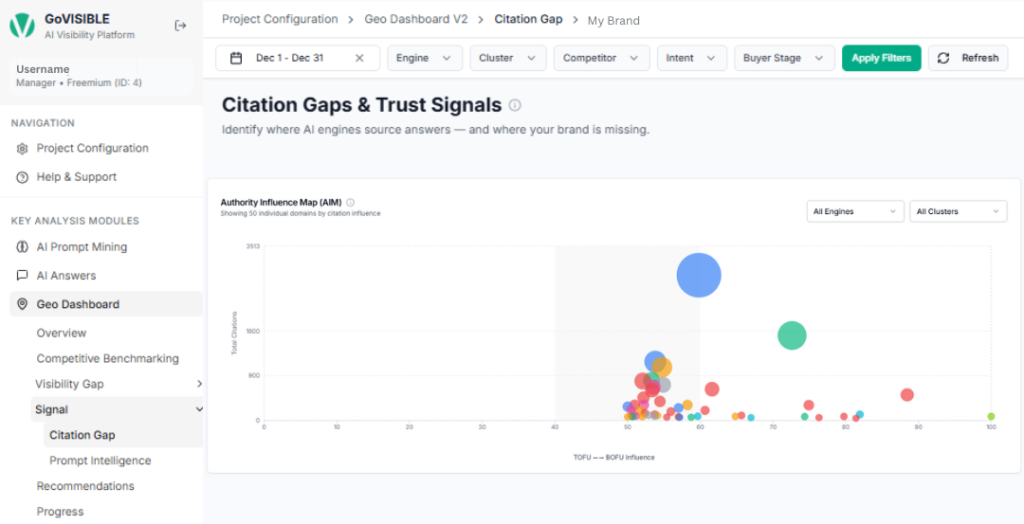
Citation Gaps & Trust Signals Section
This section gives a clear view of the sources behind AI-generated answers.
It helps teams see whether AI engines are citing brand-owned pages, third-party websites, media mentions, directories, blogs, or other external sources.
-
Authority Influence Map
The Authority Influence Map shows which domains and source categories are influencing AI-generated answers.
This helps brands understand the citation environment around their category. AI engines may rely on owned websites, blogs, review platforms, directories, media sites, forums, comparison pages, or industry resources.
The value of this feature is that it helps brands see where authority is coming from, not just whether the brand is being mentioned.
-
Brand & Competitor Web Page Citation Sources
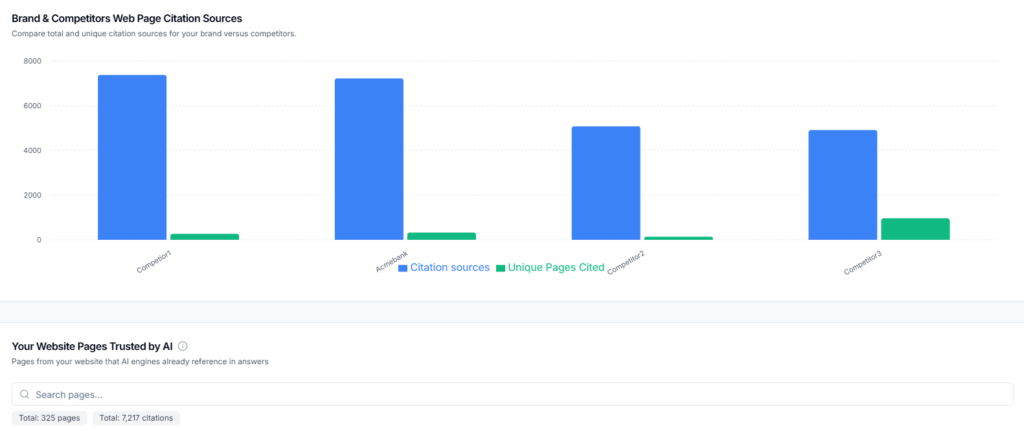
This section shows which brand and competitor web pages are being cited inside AI-generated answers across engines. Teams can track page-level metrics such as URL, AI Citation Share (%), total citations, and engines referencing the page.
The goal is to understand which pages AI engines trust most when generating responses. High-value citations often come from product pages, service pages, blogs, FAQs, landing pages, and comparison content. If AI engines rely more on outdated pages, third-party sites, or competitor content, it may indicate a citation optimization gap requiring content, structure, or schema improvements.
-
AI Source Categories Referenced
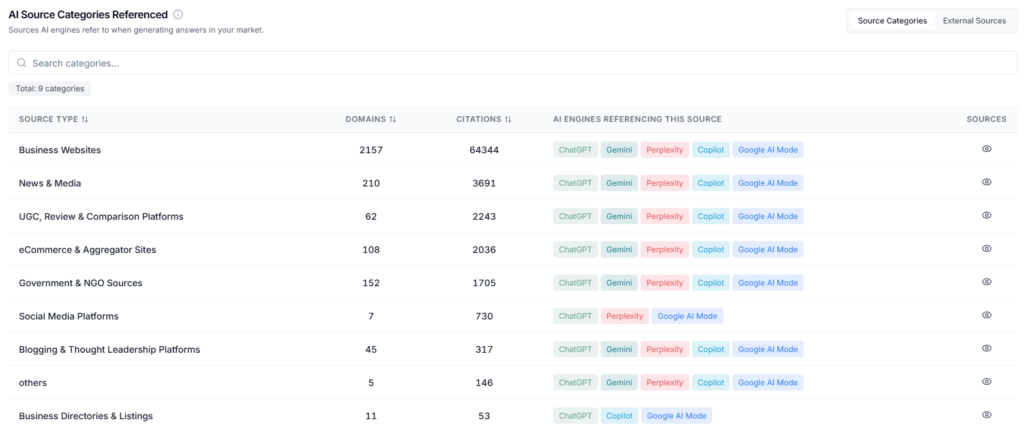
The dashboard also groups citations by source category, helping teams understand what kind of sources AI engines prefer for their brand or industry.
For example:
- If AI engines frequently cite blogs, the brand may need more educational content.
- If directories appear often, business profile accuracy and consistency become important.
- If media sources influence answers, PR and publication visibility may need to be strengthened.
- If owned pages are missing, the website content may need stronger GEO optimization.
This makes the dashboard useful for planning, not just reporting.
-
Action Center for Strategy Building
The real value of GoVISIBLE is not only in tracking citations. It also helps teams convert citation insights into strategy through the Action Center.
Once citation gaps are identified, the Action Center helps teams plan what needs to be done next. These actions may include:
- Updating cited website pages
- Creating new GEO-focused content
- Refreshing outdated information
- Building third-party mentions
- Strengthening PR and media visibility
This helps brands move from “what is happening” to “what should we do next.”
-
Ongoing AI Citation Monitoring
AI citation patterns are not fixed. Sources change, competitors publish new content, AI engines update their responses, and user prompts evolve.
GoVISIBLE helps brands monitor these changes over time so teams can keep improving their citation ecosystem instead of treating AI visibility as a one-time audit.
This makes citation monitoring an ongoing part of the brand’s GEO strategy.
Final Thoughts
AI visibility is no longer only about whether your brand appears in an answer. It is also about which sources AI engines use to support that answer.
If those citations are accurate, updated, relevant, and aligned with your current positioning, they strengthen trust. If they are outdated, incomplete, or controlled mostly by external sources, they weaken how AI engines understand and describe your brand — regardless of how well you perform on traditional SEO metrics.
The starting point is an audit: run your brand queries across AI engines, record what gets cited, and compare it against what should be cited. From there, the gaps become clear, and the actions follow.
Book a GoVISIBLE demo today and see how your brand is being cited across AI search.
0 Comments